Showing posts with label Interested Place. Show all posts

2012-06-20

Where to eat in Amed


Along the coastal strip of east Bali lies Amed village. As a tourism destination Amed refers to a long stretch of coast running from the village of Culik about 14 km eastwards incorporating the seven villages of Amed, Jemeluk, Bunutan, Lipah, Selang, Banyuning and Aas. The coastal views here are nice with slow pace of life. Though Amed is a newly developed destination but you can find some good places to eat there. Here are some of them.
Garam Cafe
3502771451_9625503df8Located at Hotel Uyah, Garam Cafe offers selection of local and international dishes. This restaurant has view of salt production field, on the dry season (April – September) you can see the production of salt in traditional way, the waitress is more than happy to explain the process of salt making.
Amed Cafe
Amed Cafe (62 363 23473) offers a good selection of international food with reasonable price. This café has good location and free internet access.
Sails
Located at Lipah village, Sails (62 363 22006) is a great restaurant with nice setting. With clean and modern nuance, Sails gives cozy atmosphere as well as extensive well thought out menu, worth a visit. Provides free pick up and drop-off around Amed area.
Barong Cafe and Restaurant
Barong Cafe and Restaurant (62 81 80 55 85 010) offers good selection of Indonesian and international cuisine. Provides free pick up and drop-off around Amed area.
Another nice place to eat is the tiny, friendly Restaurant Gede, located against the mountain after a steep descent from the Indra Udhayana Hotel, serves good fresh fish and seafood. Its terrace offers a view of rocky mountain slopes.

source:http://blog.baliwww.com

2012-06-19

What to do in Amed


Amed is an excellent choice for those who long for serenity and quiet surrounding, a good place for honeymoon and getaway vacation.  While staying in Amed there are some activities you can do here to give your vacation a little more color.
Sailing and fishing
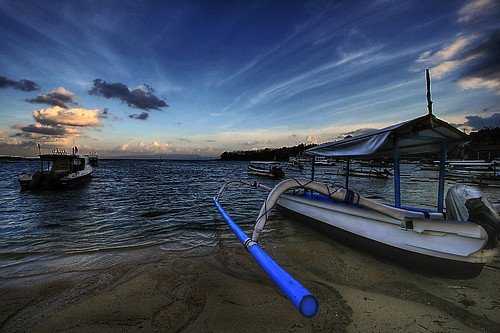
3503977232_2814edfb9bEarly morning fishing and sailing is superb in Amed; you can see hundreds of traditional fishing boats depart for their fishing exploration with beautiful red sunrise on east horizon as background. You can enjoy the sunrise while fishing or sailing. Join the early morning rush for mackerel and sunrise
Snorkeling
Due to small number of visitors Amed’s sea life is healthy and abundant’ a good news for those who want some good snorkeling. You can enjoy good snorkeling within few meters of the shore. There is a small World War II Japanese wreck in quite shallow water off Lipah Beach.
Diving
Amed has some good diving spots in Jemeluk Bay both from the beach and from boats in deeper water. Beware of the drops off that reach the depths 40 meters plus right after a gentle slope out from shore. Amed has good and healthy coral with various fish. For experienced divers, there are some good drift dives further east at Selang and Bunutan.
Massage
For those who go to Amed just for relaxing and doing nothing, you can have a traditional massage while relaxing on the beach especially at Lipah.

source:http://blog.baliwww.com

2012-06-18

Visiting Amed


Situated at Bali east coast Amed is with the nearest town, Amlapura, around 44 km away, Amed is a tourist destination that is suitable for those who longs for a quiet rustic scene and serene atmostphere. In the tourist vocabulary the word “Amed” refers to a 15-km stretch of coast from Amed via Jemeluk, Bunutan, Lipah Beach, and Banyuning to Aas.
3565736516_8d0a3e1a1f_b
2653862946_2e6c922131
To reach Amed youcan get a shuttle bus from Candidasa. The easiest way to reach Amed is still to hire your own transport with a driver. Public transportation in Amed is rare, There are bemos (mini buses) from Culik as far as Aas but mainly in the morning. Later in the day it is almost impossible to find transport; again the easiest way to get around is to hire a car and driver. Motorcycles are also widely available for rent.
3502771451_9625503df8
Amed is well-known as diving and snorkeling site especially the Japanese wreck at Lipah, as for nightlife, compare to other destinations in South Bali, you can safely assume that there is no nightlife in Amed, save dining with friends, tasting the potent Arak Madu (Balinese local spirit mixed with honey and lime), enjoying live music at Wawa-wewe restaurants or if you are lucky you can watch the traditional genjek performance.
3503977232_2814edfb9b

source:http://blog.baliwww.com

2012-06-05

Jemeluk and Its Salt


The village of Jemeluk near Amed in Karangasem regency now begins to explore and develop their resources in order to compete the neighboring villages such as Amed that have already enjoyed the limelight of tourism for years.
2357913862_b30db299ee
Jemeluk not just offer a beautiful a clean beach free of hawkers and peddlers with stunning sunrise to behold but also a unique traditional salt making activity that have been the main occupation for many inhabitants of Jemeluk for generations. And traditional salt making is the trademark of Jemeluk that is used to give a unique characteristic to the Jemeluk beach.
Jemeluk and Its Salt
The traditional salt making activity in Jemeluk is programmed to be a tourist attraction though the activity of salt making can only be seen during the dry season (from April to October), the best time to see this traditional salt making activity is around July and August.

Jemeluk and Its Salt
The process of making a salt using traditional Jemeluk technique can be summed up as follow:
First, the seawater is taken from the sea then the seawater is poured on a specially prepared land to increase the salt concentration of the soil after that the soil of field with high salt concentration is leveled in order to allow the soil to dry evenly.
Jemeluk and Its Salt
The drying process usually takes three days then after three days the salty soil is raked and filed into a bamboo cone then the salty soil inside the bamboo cone is pressed by walking on it.
Jemeluk and Its Salt
After the salty soil become solid, the seawater is poured into the cone, the salty soil filter the sea water and the filtered sea water that is dripping from the cone is collected in a big palm tree trunk then the filtered sea water is transferred to wooden drying pans made of palm tree trunks. The filtered seawater is allowed to evaporate under hot tropic sun; the seawater evaporates leaving the salt crystals ready to be harvested.
Jemeluk and Its Salt
This traditional salt making process can be seen in Hotel Uyah Amed that arranges a daily program of traditional salt making during the dry season.
Jemeluk and Its Salt

source:http://blog.baliwww.com

2012-06-03

Visiting Padang Bai


Padang Bai is located at Manggis district, approximately 53 kilometers from the city of Denpasar or approximately 30 kilometers from Amlapura. From Kuta, can be reached with the drive takes about 3 hours. This region is the region that connects the port of sailing between the islands of Bali and Lombok island. It was here that the landing of the tourists who visited Bali by sea are transported by cruise ships.


Padang Bai

Location Padang Bai is located on the coast road Klungkung, Karangasem majors turn to the right. In Padang Bai is now there were several inns and restaurants for tourists who enjoy a vacation there, and the tourists who will go or who had just come from Lombok. Here also is the traditional canoes and small motor boats are ready for hire to enjoy the water attractions. On the Parker area, the stores were lined with souvenir sellers are quite interesting wares.
Padang Bai-Bali,Indonesia
For the purpose of crossing to Lombok is ready to ferry services which serve tourists or people who go to Lombok, four times a day crossing.
What’s interesting about this object is to place the protected bay of the black rock solid so that the life under water is safe. On the east coast of Padang Bai clean white sand and thick it fun for swimming or sunbathing. Fish are milling through the rock, interesting to be enjoyed by diving or snorkeling.

source:http://blog.baliwww.com

2012-04-05

Truly Trunyan


Trunyan. Some people recognize this name as a unique village situated in Bangli regency in which the dead body is simply put under the Trunyan trees. No cremation, no burial, just let the earth change the dead body to be it should be and the soft fragrant Truyan tree surprisingly sweep away the bad smell of the dead body. Actually, it is not the only unique thing. Trunyan conceals other unique things named Batara Datonta and Barong Brutuk.
People in Trunyan call it Batara Datonta; a naked sacred statue, 4 meters in height. This statue which is considered as stone-age relic has a vivid carving especially on the face. The right hand is flexed on the axe above its shoulder; looks like he wants to stab somebody with the axe. Further Datonta’s penis dangles downward in which a hole-a symbol of vagina- is there below the penis. It is not a nasty talk. Hindu community believes that Lingga-Yoni or a symbol of Adam-Eve is the vital part in human life.
This naked sacred statue stands firmly there in Pancering Jagat Temple. People in Trunyan consider it as a symbol of one of the gods that this statue is called Batara Datonta. Batara Datonta has unen unen- the guards- which are symbolized with 21 masks.
These masks are often to be used when a dance named Barong Brutuk is shown in celebration of Pancering Jagat Temple’s anniversary. Barong Brutuk is another dance type of Barong which is danced by men, the member of youth organization. 42 days before dancing Barong Brutuk, the chosen men have to follow a series of purification activity such as: learning the sacred holy song, collecting banana leaves to make the costume of Barong Brutuk, and not doing any activity with the girls.
Barong Brutuk will be danced at 12 o’clock before noon until 05.00 pm. Portraying the concept of dichotomy in human life that is male and female, the dance is not only sacred but also entertaining. Beside the sacred procession conducted by the dancers and holy men, the show of Barong Brutuk is also followed by traditional game. The spectators can grab and tear the dried banana leaves from Brutuk’s costume while the dancers have the right to prevent it using whip. The leaves which are successfully to be grabbed then will be spread out on the field to make it fertile.
Trunyan. It seems that this village conceals many things; many sacred things. A unique village with various unique things; the dead body under the trees, naked sacred statue, and Barong Brutuk
If you wan to make trip, click here

View Trunyan Village in a larger map


Source:
http://blog.baliwww.com

2012-04-04

Gunung Kawi: A Historical Tourism


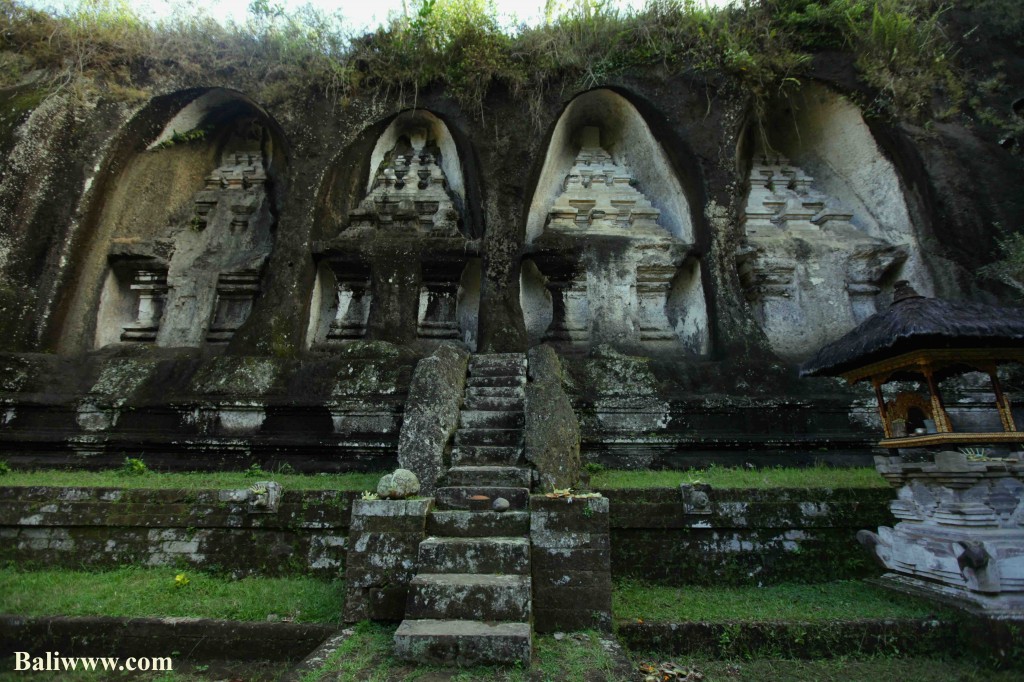
Among the travelers, especially for those who are interested on antiquities, Gunung Kawi is an appealing tourist attraction. Gunung Kawi refers to a complex of 9 rock-cut candi (shrines) carved into the cliff face, located in Tampaksiring, Gianyar Bali. The existence of these fascinating shrines which are 7 mt in height is connected with the biggest Bali Empire.
In the report written by Udayana University’s research team, it is mentioned that this shrine complex was discovered by a prominent resident (an occupation similar to governor) named HT Damste in 1920. Since that time, the government carried out restoration so that the researchers as well as visitors can enjoy the elegance and grandeur of this shrines standing along the river Pakerisan.
Famous historian, R. Goris mentioned in his articles that Gunung Kawi Temple is the place to honor King Udayana and his family. It is a conclusion after researching the inscription using Kadiri Kwadrat letters. Kadiri Kwadrat is the letters which was used by people in Kadiri Empire, East Java. For sure, Kadiri Empire was related to Bali Empire on that time since King Udayana Warmadewa from Bali married to Gunapriya Dharmapatni, the daughter of Empu Sendok from Kediri. With Dharmapatni, King Udayana had Marakata, Erlangga and Anak Wungsu.
Later on, Erlangga governed East Java and Bali was ruled by Anak Wungsu from 1049 – 1077. Under his rule, Bali was so peaceful and its land was so fertile. In the meantime, Kadiri Kwadrat letter was still used during his reign. Anak Wungsu was respected very much that when he died, his ash was put in one of the shrines. On the northernmost candi, there is a sentence in Kadiri Kwadrat letter mentioning “The King was buried in Keris (Pakerisan)”. On the candi number two, an inscription “rwanakira” meaning ‘my two children’ was carved on it.  Those two children whose ash put on the shrines are Anak Wungsu and Marakata.
Meanwhile, the other 4 shrines occupying an area on the west of river according to R. Goris are estimated as the places of the concubines of Anak Wungsu. On the southwest, there is candi number ten with “rakryan” inscription. Based on that fact, this candi is arguably considered as the place of prime minister in Anak Wungsu dynasty.
Although, the candi complex at Gunung Kawi is the place for royal family’s ash, it is not kind of graveyard. It is a holy candi where people can honor King Udayana and Anak Wungsu.

View Gunung Kawi in a larger map

source:http://blog.baliwww.com

2011-07-21

Discover The Uniqueness of Bayung Gede (II)

Bayung Gede is the mother of Balinese ancient villages concealing many unique things. For those exceptionally different customs, this village located in Bangli regency is never missed by visitors who have insatiable hunger for Balinese ancient culture. On the previous article, it has been discussed about the unique customary leadership structure. On this piece of writing, other unique customs will be revealed.
Generally, Balinese people have a custom to bury the placenta of the babies. But, Bayung Gede community places placenta in a coconut shell and hang it up on a tree in the graveyard. It sounds terrifying spooky but this tradition is still going on for years and years since hundreds years ago.
Since hundreds years ago also in Bayung Gede there is a different burial system for female and male dead bodies. Female is the symbol of earth and male is the symbol of sky and so the burial position is exchanged. The female dead bodies are buried into usual upward position while the male bodies are laid facedown. These positions according to Wayan Suwela describe the meeting of the sky and the earth.
Besides the three unique traditions above, the decision to use Bayung Gede as a model of community – based tourism project has to do with another unique custom. In Bayung Gede, new married couples are forbidden to step into home yard. They are also not considered as the part of Bayung Gede community before giving tumbakan (sort of dowry) in the form of two cows to the village and fasting. Is that all? No. New married couples are obliged to do panyekeban procession (live in a separated place to become mature people) in a small hut far away from the center of the village.

This village whose people work mostly as farmers indeed does not have written customary law. People of Bayung Gede live based on the convention which still exists since years ago and this is a fact that they can be able to live peacefully using only the convention.

source:blog.baliwww.com/

Discover The Ancient Uniqueness of Bayung Gede (I)

As a matter of fact, Bangli is the home of many villages which still hold ancient Balinese culture (Bali Aga). Panglipuran village is one of them concealing very ancient but exotic architectures. Bonyoh and Sekardadi are the other two. And Bayung Gede is the mother of the Balinese ancient villages.
Fresh air with silent green surrounding will welcome people at Bayung Gede. No one would expect that this village hides privileged customary leadership structure, privileged rules for new married couples, and privileged way in burial. For those unique cultures, Bayung Gede becomes one of 20 villages in Indonesia which attract Indonesian government to develop the tourism at this village in which the origin of the name is still unclear.
There are two versions. First report is related to a long complex myth involving the Lord Siva’s asceticism. This version is hard to be accepted by many people as facts of history. Another logical version was stated by Wayan Suwela. He argued that the name of Bayung Gede is actually Bayu Gede or “Super Power”. In the past, the ancestors needed big big power to clear a dense forest land to be a place for many people to live.
And at that place in which the origin is the forest land, people are still faithful to the ancient customary leadership system called Paduluan Sasih Nem Belas. This structure consists of 4 important positions and 16 subordinates. These 4 important persons who have titles Jero Kubayan Mucuk, Jero Kubayan Nyoman, Jero Bahu Mucuk, Jero Bahu Nyoman are free from customary fine and responsible to prepare the ceremonial stuffs. Each person of Bayung Gede community will definitely be in that structure one day as long as the person matching up to the criteria.
Paduluan Sasih Nem Belas only has responsibility in the area involving ceremonies while Kelihan Desa runs the system of government. However, Bayung Village has no customary written law or awig-awig. They use and strictly follow only the convention.

source:blog.baliwww.com/

2011-07-12

Gumang Hill

Gumang Hill is situated in Bugbug village, on the road between Candidasa and Amlapura in Karangasem Regency. This hill overlooks the majestic Mount Agung on the north and Lombok strait on the east. During a favorable weather Mount Rinjani and the island of Lombok can be seen from this hill. Gumang Hill is not a tourist resort,so there is no such a thing as entrance fee.

The peak of Gumang hill can be reached just by 40 minutes hiking and climbing from the road on the foot of the hill. On the peak of the hill you can find an old temple that is called Pura Bukit Gumang by the locals. This temple is guarded by a band of monkeys that not just roaming the temple precinct but also the forest on the slope of the hill, and sometimes they can be found searching for food on the shrines on the foot of the hill.
Gumang Hill has a great mount Agung and ocean view during the daytime, but the best panorama Gumang hill has to offer can be seen early in the morning. Yes, the view of sunrise from this hill is superb especially during the dry season (late in April up to early in October) but for the sunrise I recommend you to climb this hill around July and August.
Hunting a snapshot of sunrise from the peak of this hill is quite an adventure. There is no camping site on the peak of the hill so you have to climb the hill early in the morning (around 5 AM) in order to get to the top of the hill right in time for the sunrise. The best spot for capturing the sunrise is on the east side of the peak, right on northeast side of the temple.
The beauty of the views that you can see from the peak of Gumang is worth every ordeal you take in climbing this hill. Just take a look on the pictures to see what I mean.

source:blog.baliwww.com

2011-07-10

The Beauty of Sukawana

The Beauty fo Sukawana
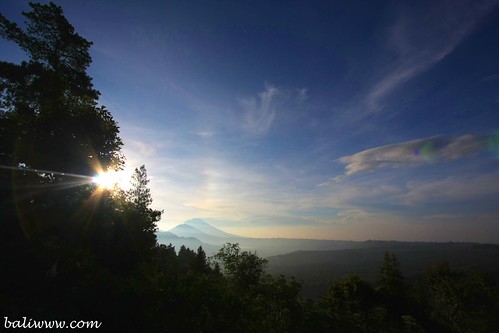
Situated on the slope of mount Batur, at the highest physical elevation of any human settlement in the island of Bali, the village of Sukawana offers a great panoramic view of Mount Batur and its vicinity; it also provides a good angle for the photographer to capture the beauty of mount Batur, Abang and Agung simultaneously.
The Beauty of Sukawana
This village is also recognized as one of the oldest and most traditional highland communities of Bali Aga or “mountain Balinese”. Bali Aga communities are well known for preserving their cultural heritage and ritual from the influence of Javanese migration in 11th century A.D. The village of Sukawana is well known for its unique Baris (warrior) dance and great temple anniversary.
The Beauty of Sukawana
The great temple in Sukawana, that its anniversary is celebrated extravagantly is Pura Puncak Penulisan, about 5 km north of Kintamani on the road towards Singaraja. Known also as Pura Tegeh Koripan, Pura Puncak Penulisan is highest temple in Bali. Based on 9th century inscriptions, it is also one of the most ancient temples in the island.
source:blog.baliwww.com

2011-07-08

The Beautiful Belandingan Village

Belandingan Village
Perched on the east slope of mount Batur, Belandingan is a remote village, which is quite difficult to reach since the road to this village is bumpy. However, Belandingan worth every bit of your effort to reach it. Belandingan has beautiful panorama, unique culture and of course pollution-free and fresh air, even on the way to this village you can enjoy the beautiful views along the bumpy road.
Belandingan is located on a hilly area, make it suitable for jungle tracking and agro-tourism. Most of the inhabitant of Belandingan are farmers and their farms are usually far from their house so they made huts (pondok) in their farms and live there most of the time. They usually go back to their house when there is a temple ceremony in the village.
In addition to the picturesque view of the surrounding, Belandingan also has a unique traditional house architecture compare to other Balinese traditional house architecture. Belandingan’s traditional house is all-inclusive house, which its kitchen is intergrated into the house while other Balinese traditional house has seperated kitchen within the house compound. the Belandingan’s traditional house is almost enterily made of bamboo which is make it unique and eco-friendly.
In short, Belandingan is an interesting village that worth a visit.

Source:blog.baliwww.com

2011-07-06

Central Ubud Overview

Central Ubud is an interesting area where you can make hints what Ubud has to offer. Central Ubud has great restaurant and warungs, accomodation and interesting tourist destinations that serve as hallmarks of Ubud.
In Central Ubud you can visit Puri Saren, Ubud’ s main palace. This palace lies on the northeast comer of the town main crossroads facing the market, the exact center of Ubud. This is an elegant palace with cool nuance. Visitors are free to roam in inner courtyard of the palace to see the ornate thatched Bale (traditional house), royal heirlooms, and numerous colonial-era photographs.
Other interesting site is Pura Saraswati next to Puri Saraswati Bungalows, the royal temple of Ubud, that is situated near the Puri Saren Agung, behind Cafe Lotus. The temple is a masterpiece of I Gusti Nyoman Lempad. The visitors can find a magnificent lotus pond, beautiful garden, numerous of beautifully carved Bale and shrines. This temple is dedicated to the goddess of learning, Dewi Saraswati.
For art lovers, Central Ubud has Puri Lukisan, the “Painting Palace” of Ubud. This museum not just offers beautiful painting but also magnificent statues, a nice place to relax while enjoying beautiful work of art.
Central Ubud houses good restaurants and warungs that have been known as Ubud’s legends.
Ibu Oka’s roasted pig is a popular eating establisment  in Ubud.  The food stall has stood here for the past 20 years, a legend. The babi guling (spit-roasted pig) here is world-famous, and this humble eating place is virtually a place of pilgrimage. The roast pork is served with rice and spiced veggies. There are normal tables and chairs but you can also sit on the floor at low tables inside the bale (pavilion).
Next to Ibu Oka’s, across Kanjeng Street is Café Lotus. This cafe provides you not just delicious food and excellent beverage but also nice and pleasant surroundings. Surrounded by lotus pond and impressive Ubud palace’s family temple rise majestically in the background, a gamelan plays daily in the small raised wantilan will give a relaxing effect to you and if you happen to come there when the lotus is bloom you will surely enjoy the most soothing view in Ubud and of course, at a reasonable cost.
Ary’s Warung is also a good choice. This eatery maintains its long and impeccable reputation of providing friendly service and delicious dishes. The warung has two levels; if you choose to sit downstairs, at street level, you will be surrounded by warm finishes of teak and coconut wood, marble and natural stone, antique wall decorations and tropical greenery with a very stylish bar setting, this section usually for luncheon. Or, upstairs on the open-air terrace, a spacious room, an open tree-lined veranda, which seems to catch whatever cooling breezes are present at the time. You can lounge in oversized rattan chairs while enjoying the view of Ubud’s main street and village temples.
Another great restaurant is Casa Luna, a very large restaurant but with excellent interior design and relaxed tropical atmosphere. Apart from delicious food, Casa Luna’s  attentive staff even watch your children while you are eating.  The Balinese food and homemade cakes and desserts served in Casa Luna are favorite as well as the delicious Mediterranean dishes.
Central Ubud also offers good range of accomodation for all kinds of traveller, here are some good choices :
Pradha Guest House is situated just a stone throw from Café Lotus close to Ibu Oka’s. Pradha Guest House offers comfortable accomodation  in reasonable prices. This guest house also has swimming pool, restaurant and spa.
Villa Chempaka is good mid-range choice. It is offers balinese style villa with complete amenities, wooden floor,  swimming pool, and terrace with garden and rice field view.
Samhita Garden is great choice for upmarket travellers. It offers 9 superior bungalow, 2 suites and 2 villas. The room and villa have complete amenities and entertaiment facilities. Samhita Garden provides facilities such as swimming pool, bar and restaurant.
The newest Komaneka in Ubud is designed as a sophisticated and contemporary lifestyle destination. It’s elegant villas, each with its private pool, and spacious suites are completed with an Indonesian fine dining restaurant, luxurious spa-villa, and wedding chapel

source:blog.baliwww.com